Core system · Electrical
Electrical
Primary standard: NEC 2023 (NFPA 70)
Reading a residential electrical system like an inspector: what the panel tells you, where GFCI and AFCI protection is required, how to spot common problems, and the standard math behind voltage-drop and load calcs. The 2023 NEC is currently the most-adopted edition; the 2026 edition was issued by the NFPA Standards Council in August 2025 but has minimal state adoption so far.
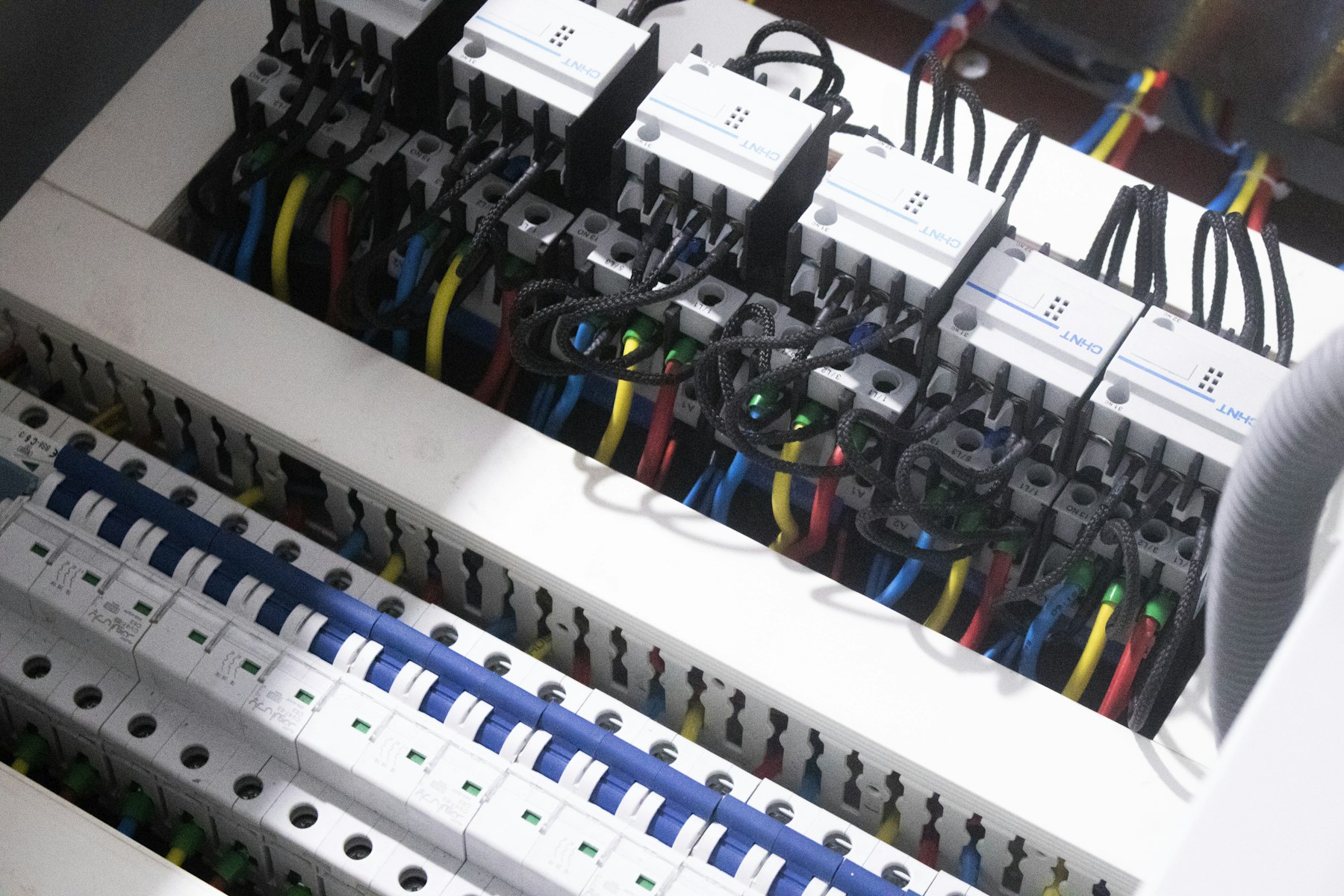
Photo · Mostafa Mahmoudi on Unsplash
Overview
The National Electrical Code (NFPA 70) is the model code that most US states adopt as their electrical rulebook. It is updated on a three-year cycle. As of this writing, the 2023 edition is in force across most of the country; some jurisdictions still enforce 2020 or 2017. The 2026 edition is published but not widely adopted yet. Always confirm the edition in force where you live — your local building department will tell you.
Modern residential service is typically 100 A, 150 A, 200 A, or 400 A at 120/240 V single-phase. New construction defaults to 200 A; homes adding EV chargers, heat pumps, or induction cooking are increasingly going to 400 A. Service size is driven by the load calculation in NEC 2023 §220, not by round numbers.
Reading a panel
When you open a panel cover (dead-front on), the things a pro looks at in the first thirty seconds:
- Main breaker size. Usually printed on the handle: 100 / 150 / 200 / 400. That is the service ampacity — the ceiling on total simultaneous load.
- Breaker types. Look for standard, GFCI (usually with a "TEST" button), AFCI (also has a test button, sometimes different color), and dual-function (DF/CAFCI) — required in many bedroom / living-area circuits.
- Wire gauge to breaker size. 12 AWG copper on a 20 A breaker, 14 AWG copper on a 15 A breaker, 10 AWG on 30 A — mismatches (a 20 A breaker feeding 14 AWG) are the #1 dangerous DIY find.
- Neutral / ground bar bonding. Neutrals and grounds bond only at the service disconnect. In a downstream sub-panel, they must be kept separate — a common wiring error when adding one.
- Double taps and double neutrals. Only breakers listed for it may accept two conductors on one lug. Two hot conductors on a single lug not rated for it is a hazard.
- Signs of heat or arcing. Discoloration around any terminal, melted insulation, or an odd smell. Stop and call an electrician if you find any of these.
The dead-front should stay on during a homeowner walk-through — removing it exposes bus bars and is only for licensed professionals.
GFCI and AFCI, in plain English
GFCI
Ground-Fault Circuit Interrupter
Cuts power when it detects current escaping to ground (typically via a person). Trips at 6 mA within about 25 ms — per UL 943 Class A. That's fast enough to prevent electrocution in most household scenarios.
NEC 2023 §210.8(A) requires GFCI protection for 125–250 V receptacles ≤ 150 V-to-ground on single-phase circuits in twelve dwelling-unit locations, including: bathrooms, garages and accessory buildings, outdoors, crawl spaces at or below grade, basements, kitchens (all countertop and in-area), areas with a sink and food-prep provisions, near sinks (within 6 ft of the bowl), near tubs and showers (within 6 ft), boathouses, laundry areas, and indoor damp/wet locations (new in 2023).
AFCI
Arc-Fault Circuit Interrupter
Detects the electrical signature of an arcing fault — the kind of spark that starts fires inside walls at loose connections and damaged cords. Different job than a GFCI; both are often needed on the same circuit.
NEC 2023 §210.12(B) requires AFCI protection on all 120 V, single-phase, 10 / 15 / 20 A branch circuits supplying outlets (receptacles and lighting) in fourteen dwelling-unit areas: kitchens, family rooms, dining rooms, living rooms, parlors, libraries, dens, bedrooms, sunrooms, recreation rooms, closets, hallways, laundry areas, and similar rooms (including finished basements). 10 A circuits were added in 2023.
Tamper-resistant receptacles (with internal shutters) are required for all 15 A and 20 A, 125 V / 250 V non-locking receptacles in dwelling units per NEC 2023 §406.12. Exception: receptacles more than 5½ ft (1.7 m) above the floor.
Dedicated circuits that must exist
- Two 20 A kitchen small-appliance circuits. NEC 2023 §210.11(C)(1) — at least two, feeding countertop / breakfast / dining receptacles per NEC 2023 §210.52(B).
- One 20 A laundry circuit. NEC 2023 §210.11(C)(2) — no other outlets on it.
- One 20 A bathroom circuit. NEC 2023 §210.11(C)(3) — may serve receptacles in one or more bathrooms, but no other loads if it serves more than one bathroom.
Self-inspection checklist
A homeowner-scale walk-through. Tick items as you go — they're saved in your browser, not to a server. Anything that fails, flag for a licensed electrician.
Interior electrical walk-through
0 / 10This checklist tracks your progress locally — nothing is saved to a server.
Voltage-drop calculator
For sizing long runs — a workshop feeder to a detached garage, an EV charger 90 feet from the panel, a well pump at the property line. NEC 2023 §210.19(A) IN #4 is an informational note, not an enforceable rule — but ≤ 3% branch and ≤ 5% total is the industry design target and any AHJ can adopt it as an amendment.
Voltage-drop calculator
NEC 210.19(A) Informational Note No. 4 · single-phase, 2-wire
4.44 V drop · 3.70% of supply
Between 3% and 5% — over the branch-circuit target but under the combined feeder+branch ceiling. Consider going up one wire size for motor loads, EV chargers, or long runs to detached structures.
K constant used: 12.9 Ω·cmil/ft (copper, approximate DC value near 75 °C). NEC Chapter 9 Table 9 gives more accurate AC impedance including reactance and power factor — an electrician sizing a real circuit should use it. This calculator is a first-pass estimator, not a design tool.
Codes & standards referenced on this page
| Standard | Section | What it covers |
|---|---|---|
| NEC 2023 (NFPA 70) | §210.8(A) | GFCI in dwelling units — 12 locations |
| NEC 2023 | §210.12(B) | AFCI in dwelling units — 14 room types |
| NEC 2023 | §210.11(C)(1)–(3) | Small-appliance, laundry, bathroom dedicated circuits |
| NEC 2023 | §210.19(A) IN #4 | Voltage-drop recommendation (informational) |
| NEC 2023 | §406.12 | Tamper-resistant receptacles |
| NEC 2023 | §110.26 | Working space around electrical equipment |
| NEC 2023 | §220 | Branch-circuit and service load calculations |
| UL 943 | §Class A | GFCI trip characteristics — 6 mA / ~25 ms |
| IRC 2024 | §R314 / R315 | Smoke and CO alarms |
Reminder
This page is guidance, not a permit.
Model codes are adopted (and amended) by each state and municipality. Always confirm the edition in force where you live and pull permits when the work requires it. When in doubt, hire a licensed professional.